Tanzania’s blue economy is increasingly becoming a data story.
Researchers are collecting new information from Tanzanian waters that could help the country better understand its marine resources and make stronger decisions around fisheries, conservation and investment.
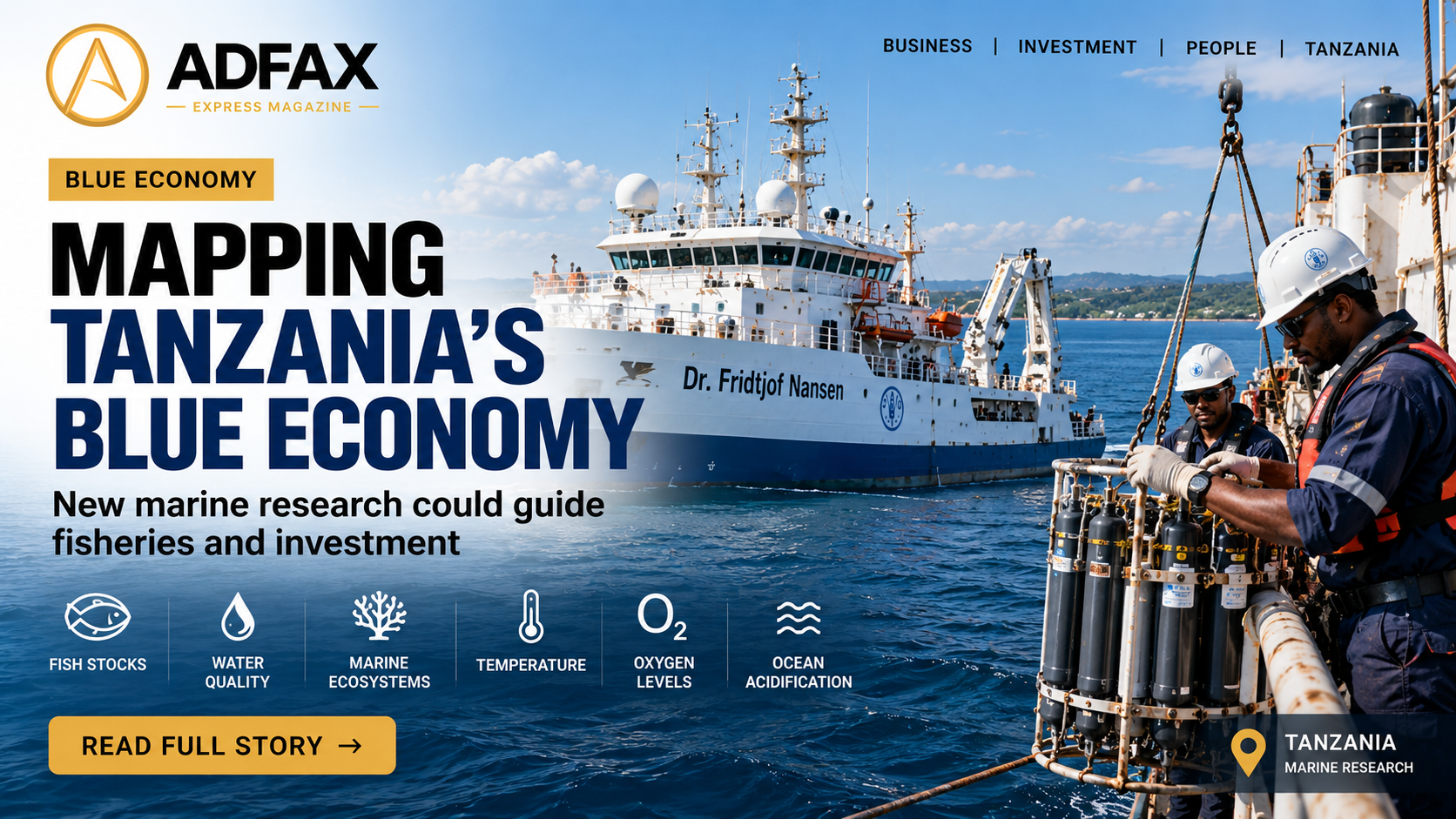
The work is being carried out aboard the Dr Fridtjof Nansen, a specialised Norwegian research vessel operating under the EAF-Nansen Programme in cooperation with the Food and Agriculture Organization of the United Nations.
The research is examining several important areas, including:
Fish abundance and distribution
Water quality
Aquatic plants and ecosystems
Water temperature
Oxygen levels
Ocean acidification
The information is intended to strengthen understanding of what exists in Tanzania’s waters, how marine ecosystems are changing and how those resources can be managed sustainably.
Why Marine Data Matters
Blue-economy investment requires more than coastline and natural resources.
Investors, policymakers and fisheries managers need credible information before deciding where development can take place, how much resource use is sustainable and what environmental risks must be managed.
Scientific marine data can support several areas.
Fisheries management.
Better information about fish stocks can help determine where fishing pressure is sustainable and where protection may be required.
Aquaculture development.
Water quality, temperature and environmental conditions can influence where aquaculture investments are viable.
Marine conservation.
Data can help identify sensitive habitats and biodiversity that require protection.
Climate resilience.
Monitoring oxygen, temperature and acidification can help Tanzania understand how climate change is affecting marine ecosystems.
Investment planning.
Reliable environmental and resource data reduces uncertainty when evaluating blue-economy projects.
Tanzania Already Has Significant Blue-Economy Potential
Tanzania has a large aquatic-resource base across its coastline and inland waters.
FAO reported in July 2026 that Tanzania is the world’s sixth-largest producer of inland capture fisheries, at around 440,000 tonnes annually, and the third-largest producer of farmed seaweed, producing about 132,200 tonnes.
That creates economic opportunities across:
Fishing and processing
Aquaculture
Seaweed production
Marine logistics
Cold-chain infrastructure
Tourism
Marine biotechnology
Environmental services
But unlocking those opportunities sustainably depends on understanding the resource base.
Science Before Investment
One of the important lessons from the current research is that blue-economy growth cannot be based on assumptions alone.
TAFIRI maintains research vessels, laboratories and aquaculture research facilities specifically to provide the scientific foundation required for sustainable fisheries and blue-economy development.
This type of research can help Tanzania move from simply identifying marine potential to developing bankable, sustainable and properly managed economic opportunities.
ADFAX Perspective
Data may become one of Tanzania’s most valuable blue-economy assets.
A coastline, fishing grounds or aquaculture potential can attract interest — but credible scientific knowledge allows government and investors to understand what can actually be developed sustainably.
The stronger Tanzania becomes at mapping its aquatic resources, monitoring ecosystem health and translating scientific findings into investment planning, the stronger its blue-economy proposition becomes.
The opportunity is therefore not just to extract more value from the ocean.
It is to build an economy where science, investment and conservation move together.
Follow ADFAX Express Magazine for blue-economy, investment and sector intelligence shaping Tanzania’s future.