
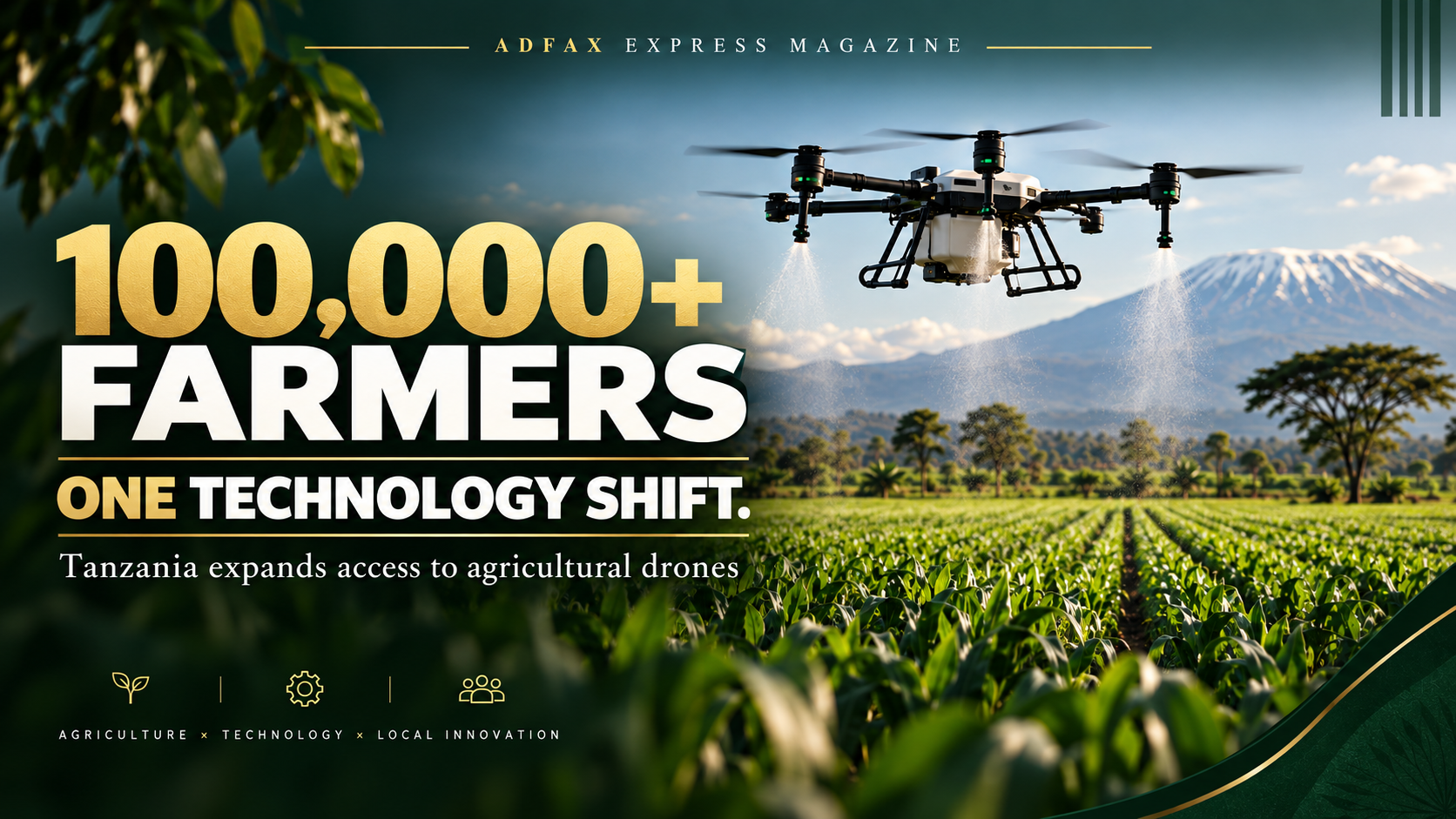
Tanzania’s agricultural transformation is increasingly becoming a technology story.
More than 100,000 small, medium and large-scale farmers are expected to gain access to agricultural drone technology following a new partnership between MATI Technologies Company Limited and agri-tech platform MazaoHub.
The two companies signed a cooperation agreement on September 7, 2026, aimed at expanding farmers’ access to drone services for activities including crop spraying and crop monitoring.
What makes the development particularly significant is the focus on accessibility.
Agricultural drones have traditionally been associated with large commercial farms because of acquisition costs and technical requirements. Under the new arrangement, farmers are expected to access the technology through service-based models and MazaoHub’s existing agricultural network, potentially allowing smaller producers to benefit without necessarily purchasing their own equipment.
From Manual Spraying to Precision Agriculture
Crop spraying remains one of the most labour-intensive and potentially hazardous activities in farming.
Drone technology can enable farmers to cover agricultural land faster and apply crop-protection products more consistently while reducing direct human contact with chemicals.
MATI Technologies has previously said its locally developed agricultural drones can spray approximately an acre within five to eight minutes, while supporting more accurate application and reducing operational time.
For farmers, that creates potential benefits across three major areas:
Efficiency.
Faster spraying can allow producers to manage larger areas within shorter operating windows.
Precision.
More controlled application may reduce unnecessary chemical use and improve coverage.
Safety.
Reducing direct exposure to agrochemicals can improve working conditions for farmers and agricultural workers.
The Bigger Story: Technology Built in Tanzania
There is another important dimension to this development.
MATI Technologies is developing agricultural drone technology locally, meaning the story is not simply about Tanzania adopting imported technology. It is also about the emergence of domestic technology companies capable of designing solutions around local economic challenges.
That creates wider opportunities around engineering, technical skills, drone maintenance, software, data services, agricultural extension and technology entrepreneurship.
Smallholder Access Could Be the Real Breakthrough
The success of agricultural technology should ultimately be measured not only by how advanced it is, but by how widely farmers can access it.
MazaoHub says its partnership with MATI will integrate drone services into its agricultural ecosystem and Farm Clinics, creating additional channels through which farmers can access precision spraying services.
If that model scales effectively, agricultural drones could shift from being viewed as equipment reserved for large farms to becoming a shared agricultural service available to thousands of smaller producers.
ADFAX Perspective
The bigger transformation may not be the drone itself — it is the service model around it.
When expensive agricultural technology can be shared, rented or accessed as a service, the barrier to adoption falls significantly.
For Tanzania, this creates an opportunity to build a more productive agricultural economy where technology, local manufacturing and digital platforms work together to reach the farmer.
As agriculture remains one of the country’s most important economic sectors, innovations that improve productivity while reducing cost, time and occupational risk could become increasingly important in determining how competitive Tanzanian agriculture becomes.
Follow ADFAX Express Magazine for agriculture, investment, technology and sector intelligence shaping Tanzania’s economy.