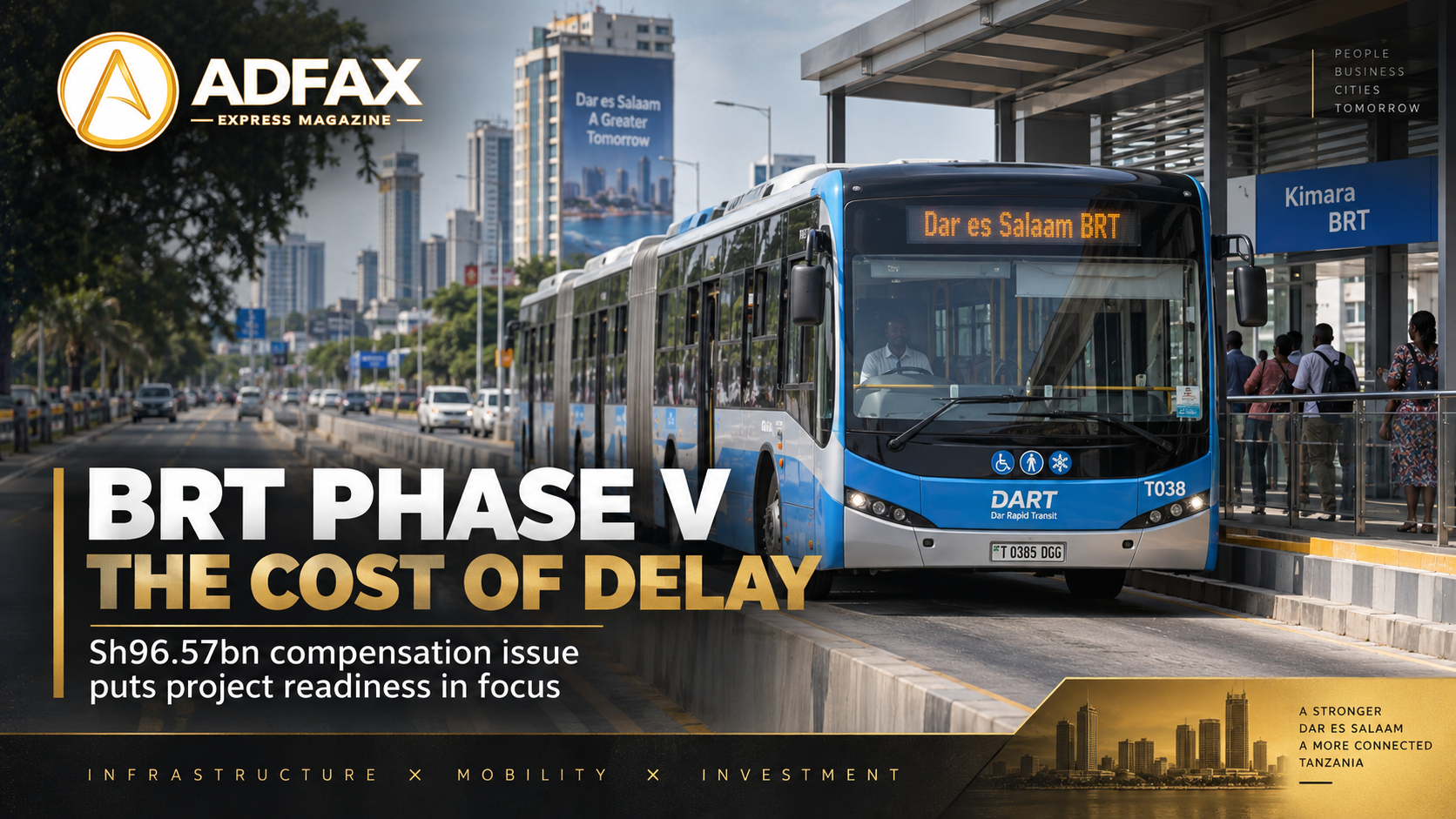
Dar es Salaam’s next major public-transport expansion is facing an important implementation test.
BRT Phase V is intended to expand the city’s rapid-transit network across key high-demand corridors and strengthen connections between residential, commercial and employment areas.
However, recent reporting based on the Controller and Auditor General’s findings says Sh96.57 billion in compensation remains outstanding for people whose properties are affected by the project. Delays in settling these claims could hold up implementation and potentially increase construction costs.
A Major Urban Mobility Investment
Official DART documentation describes Phase V as a 27.6-kilometre expansion connecting major corridors including Mandela Road from Ubungo, Tabata–Segerea and Kigogo, while integrating with other phases of the wider BRT network.
The latest DART planning documents indicate construction is scheduled to begin in 2026, with operations expected from 2028.
The project is backed by €178 million in financing from Agence Française de Développement (AFD) as part of efforts to develop a more sustainable urban transport system in Dar es Salaam.
Why Compensation Matters to Infrastructure Delivery
Compensation is not simply an administrative step.
For large infrastructure projects, unresolved land acquisition can affect:
Project timelines.
Contractors cannot efficiently access all required sites when land and property issues remain unresolved.
Project costs.
Delays can introduce additional contractor claims, financing costs and price escalation.
Affected households and businesses.
People whose properties are acquired need certainty to relocate, rebuild or reorganise their economic activities.
Investor and development-partner confidence.
Major projects depend on strong coordination between financing, procurement, land acquisition and implementation agencies.
The CAG has reportedly warned that delays could expose government to higher costs, while applicable land laws require timely and fair compensation.
More Than a Transport Project
The economic value of BRT Phase V extends beyond buses and roads.
Improved urban mobility can reduce travel time, strengthen access to workplaces and markets, and improve connectivity between communities and economic centres.
AFD describes the wider objective as reducing congestion and pollution while improving access to services in one of Africa’s fastest-growing cities.
ADFAX Perspective
The lesson is simple: major infrastructure succeeds when financing, land acquisition, procurement and execution move together.
Securing project funding is only one part of infrastructure delivery.
As Tanzania continues investing in transport, energy and other large-scale infrastructure, early resolution of compensation and institutional responsibilities will be increasingly important for controlling costs and delivering projects on time.
For Dar es Salaam, successful completion of BRT Phase V would represent another important step toward a more connected and productive city.
Follow ADFAX Express Magazine for infrastructure, investment and business intelligence shaping Tanzania’s development.