Tanzania is positioning its livestock and fisheries sectors for a stronger role in international trade as new discussions with Qatar focus on investment, processing, market access and value addition.
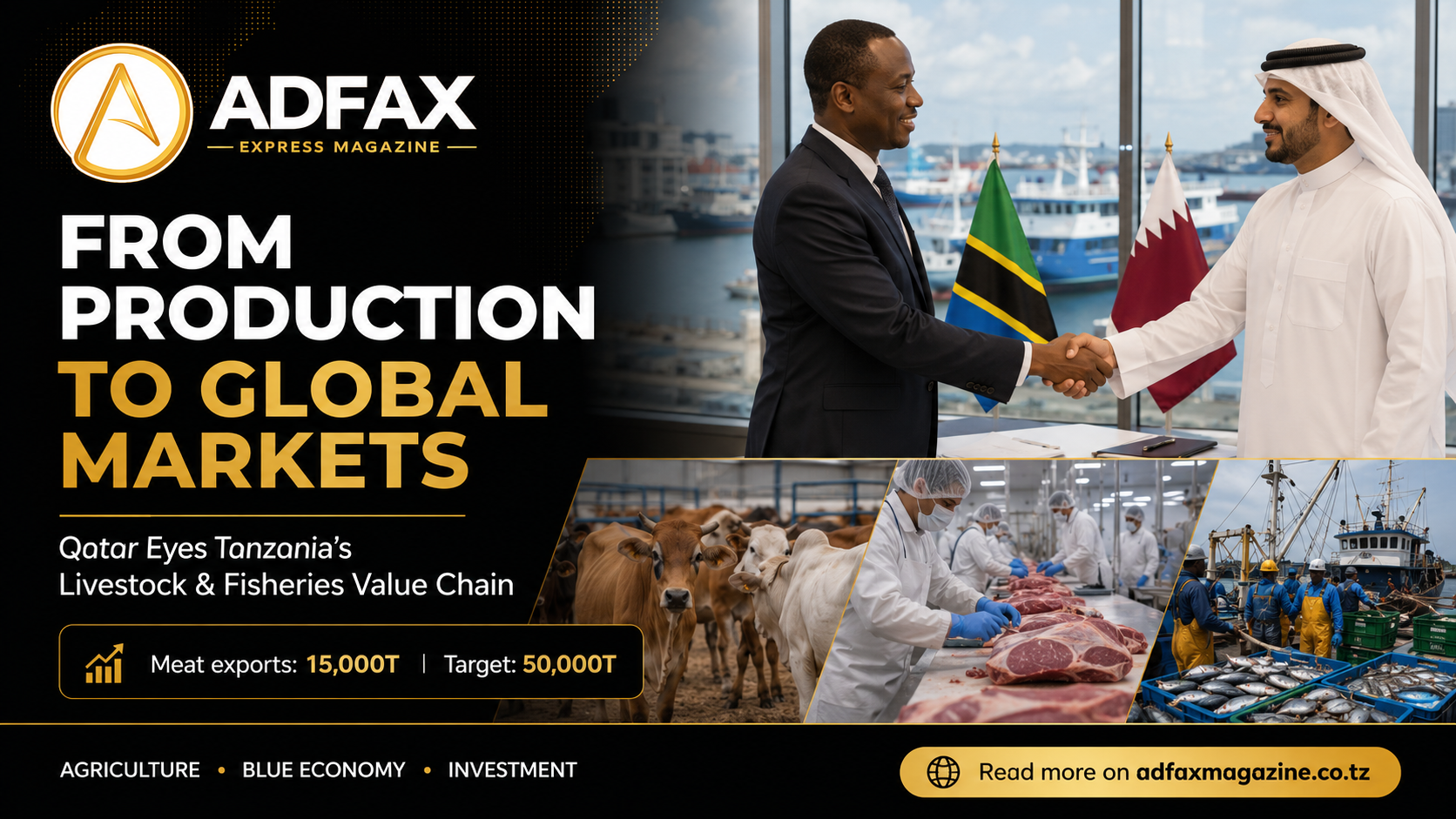
The Government of Tanzania has expressed readiness to work with Qatari investors in areas including meat production and processing, poultry, fisheries infrastructure and expansion of livestock-product markets across the Middle East. The discussions were held in Dar es Salaam between Minister for Livestock and Fisheries Ambassador Dr Bashiru Ally Kakurwa and Dr Khalid bin Mohammad Al Attiyah, former Deputy Prime Minister of Qatar and Chairman of Thirty-Five Investment Holding.
From Production to Export Value
The strategic opportunity is bigger than simply producing more livestock or fish.
For Tanzania, the greater economic value lies in building complete value chains that connect:
Production → Processing → Standards → Cold Chain → Logistics → Export Markets
Tanzania’s meat exports have grown from approximately 1,000 metric tonnes in 2021 to nearly 15,000 tonnes today, while the country is targeting at least 50,000 tonnes annually.
Tanzania already exports meat to markets including Qatar, Oman, the United Arab Emirates, Saudi Arabia, Kuwait, Bahrain, Jordan, Hong Kong, Vietnam and Comoros.
That growth demonstrates the existence of international demand.
The next challenge is to increase Tanzania’s ability to supply those markets consistently, competitively and at the required standards.
Processing Will Determine the Real Value
Increasing exports will require stronger investment in processing plants, food safety, certification, packaging, transport and cold-chain infrastructure.
These areas determine whether Tanzania participates mainly as a producer of raw commodities or captures more value through processed and higher-value products.
This is particularly important in meat exports, where reliable logistics and international quality standards are essential for accessing premium markets.
A stronger processing ecosystem can also generate opportunities beyond large investors.
Farmers, transport companies, packaging suppliers, veterinary-service providers, cold-storage operators and local manufacturers can all become part of the wider value chain.
Poultry Adds Another Growth Opportunity
Poultry is another area identified for potential investment.
The Government has launched a ten-year poultry strategy aimed at strengthening and formalising the sector, with opportunities across feed production, vaccines, agricultural inputs, distribution and productivity improvement.
A competitive poultry industry depends on more than growing bird numbers.
Feed availability, animal health, processing capacity and efficient distribution all influence cost and competitiveness.
This creates investment opportunities across the entire supply chain.
Fisheries and the Blue Economy
The investment discussion also extends into Tanzania’s fisheries sector.
The Government has proposed further engagement between Thirty-Five Investment Holding and Tanzania Fisheries Corporation to explore opportunities in fisheries investment.
Tanzania has also invested in infrastructure at Kilwa Masoko Fishing Port, including cold storage, processing areas, ice production, freezing facilities and vessel-support infrastructure.
Further opportunities have been identified around deep-sea fishing, particularly tuna, as well as processing and value addition.
These investments could help Tanzania capture more economic value from its marine resources instead of relying primarily on the harvesting stage.
A Regional and Global Opportunity
The wider significance of these discussions is the possibility of connecting Tanzanian production directly with higher-value international markets.
Livestock, poultry and fisheries all have potential to become stronger export industries if investment focuses on productivity, processing, standards and logistics.
The opportunity therefore extends beyond bilateral Tanzania–Qatar cooperation.
It is about strengthening Tanzania’s ability to compete in global food markets.
ADFAX Perspective
Tanzania already has the resources.
The next stage is about building the systems around them.
If investment is directed toward complete value chains rather than production alone, the country can create stronger export industries while opening opportunities for farmers, processors, logistics providers, manufacturers and supporting businesses.
The real opportunity is not simply to export more meat or fish.
It is to transform Tanzanian production into globally competitive industries.